
How the study worked
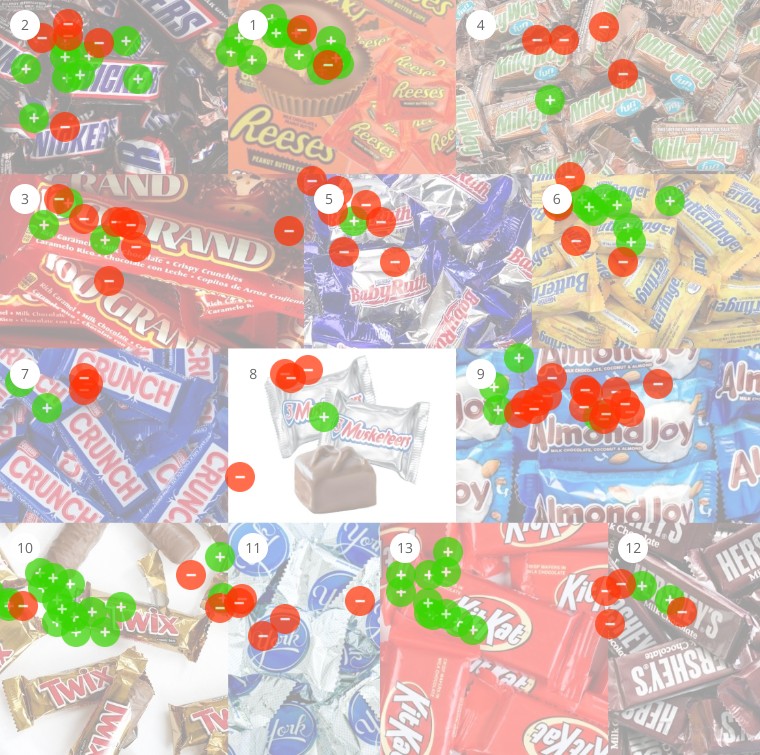
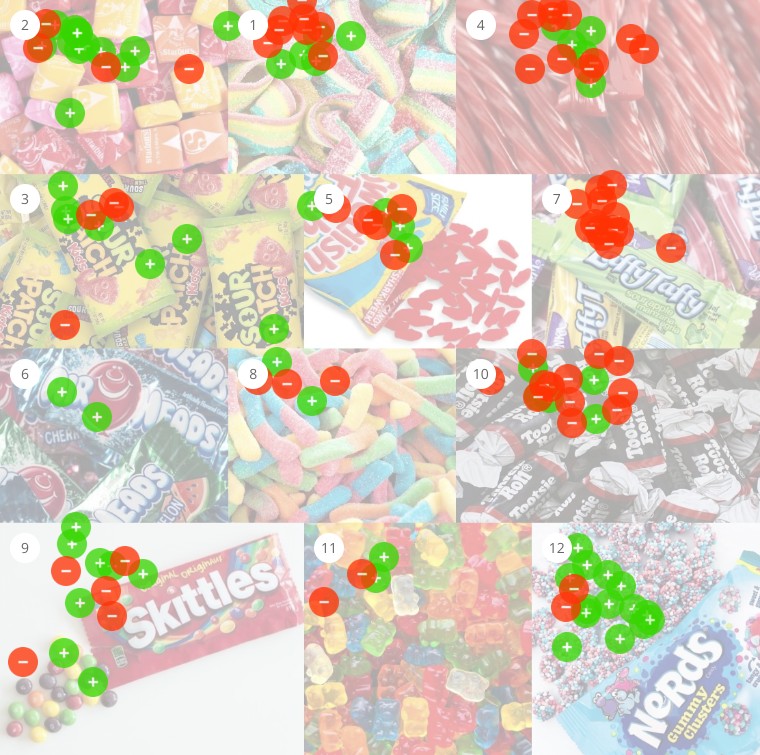
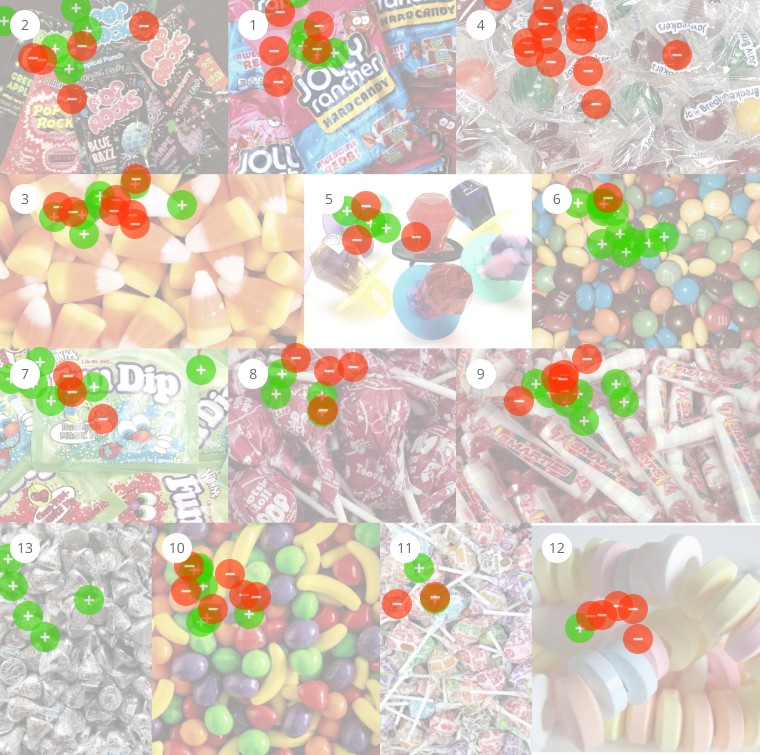
Three boards, sourced from Google Images on the search terms “Halloween candy” and “trick or treat candy,” one board each for chocolate bars, chewy candy, and bite-size and suckers. The prompt was the whole study: drag the green dots to the candy you like the most and the red dots to the candy you like the least.
Twenty-six people completed it in October 2025. The dot maps above are the raw result. At the report’s 75% threshold the 24 scored candies sort into three groups: eight resonant, eight resistant, eight contested. The report prints every score with the count it came from, and so does this page. See the full report.
Texture is trust
More than flavour, more than brand, texture predicts the pile. The candies with satisfying physical feedback, the snap of a KitKat, the shell-crack of M&Ms, the crunch-then-gummy of a Nerds cluster, consistently beat the candies that require negotiation. People want their treats to cooperate. The effort-to-reward ratio is the whole sort.
Line the 24 candies up by the share of their dots that were green and the room does not spread its opinion across a range. It sorts into three piles, and the piles are texture.
Figure 2 · Every candy, ranked
Principal finding
Texture is trust. Crisp, crunchy, snap: resonant. Too hard, too sticky, texturally confusing: resistant. Chocolate bought nothing on its own. Three chocolate bars were refused, and the most emphatic large-crowd rejection on the wall, Almond Joy at 78.95% red, is a chocolate bar with coconut in it.
What won: the hall of fame
Eight candies cleared the 75% positive threshold. What unites them is not just chocolate, though there is plenty of it. It is textural satisfaction, brand recognition, and the kind of flavour reliability you can set your watch to. Every one of them delivers exactly what it promises.
Resonance
Hershey’s Kisses
Foil-wrapped drops, a pile of silver. A small crowd, all of it green
100% green · 5 of 5 dotsResonance
Airheads
Only two dots landed on it. Both were green
100% green · 2 of 2 dotsResonance
M&Ms
The trick-or-treat currency, shell-crack and all. Practically canonical
93% green · 13 of 14 dotsResonance
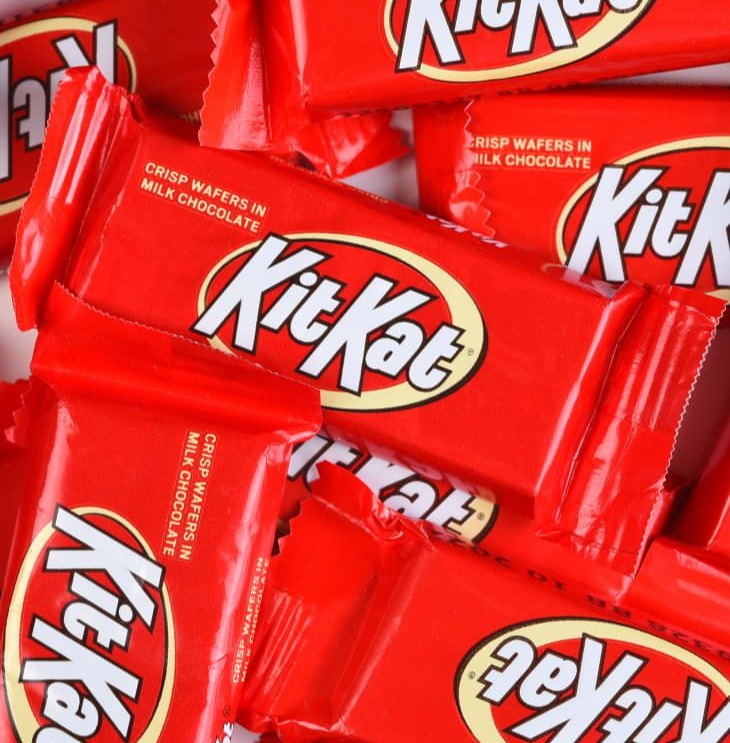
KitKat
Wafer layers and the ritual snap. Engineering as much as candy
92% green · 11 of 12 dotsResonance
Nerds Gummy Clusters
Crunchy shell over a gummy centre. The newest entry on the wall
88% green · 14 of 16 dotsResonance
Reese’s
Peanut butter and chocolate in the same bite, every time, no surprises
87% green · 13 of 15 dotsResonance
Twix
Caramel over shortbread. One of the two biggest crowds on Board 1
84% green · 16 of 19 dotsResonance
Starburst
Bright fruit chews, a controlled chew rather than a fight
76% green · 13 of 17 dotsThe Nerds surprise
Nerds Gummy Clusters are the unexpected champion: a newer entry with a chaotic texture, crunchy shell and gummy interior, and it took 87.5% on one of the bigger crowds of the chewy board. Novelty did not hurt it because the novelty is textural. It cooperates in a new way.
What lost: candy that fights back
This is where candy goes to be actively resented. Not ignored: rejected. Eight candies crossed the 75% negative threshold, three of them without a single green dot, and they share a set of failure modes: excessive hardness, sheer stickiness, polarising flavours, and textures that require negotiation rather than reward.
The nougat problem
Milky Way, Baby Ruth and 3 Musketeers all landed here. They are chocolate bars, they are famous, and they share a nougat-forward formulation. What felt substantial to a previous generation now reads as filler. These are the chocolate bars time forgot.
The coconut catastrophe
Almond Joy at 78.95% red is not an anomaly. It is a verdict. Nineteen dots landed on it, the joint-largest crowd on the chocolate board, and fifteen were red. Shredded coconut and chocolate, once novel, now signals divisive at best. The almond on top did not help.
Resistance
Jawbreakers
Candy that fights back. The name telegraphs the problem
100% red · 13 of 13 dotsResistance
Laffy Taffy
Sheer stickiness. The jokes on the wrapper did not help
100% red · 13 of 13 dotsResistance
York Peppermint Patties
Mint and chocolate, rejected with surprising unanimity
100% red · 5 of 5 dotsResistance
Baby Ruth
Nougat, peanuts and a name from another era
88% red · 7 of 8 dotsResistance
Candy necklace
Chalky beads on elastic. A novelty format that prioritises gimmick over taste
83% red · 5 of 6 dotsResistance
Milky Way
The nougat bar time forgot
80% red · 4 of 5 dotsResistance
3 Musketeers
Whipped nougat and nothing else
80% red · 4 of 5 dotsResistance
Almond Joy
Coconut, chocolate, an almond on top. The most emphatic large-crowd rejection on the wall
79% red · 15 of 19 dotsThe twin test
The cleanest pair in the data is two hard candies. Both are literally hard. One breaks for you. One makes you do the work.
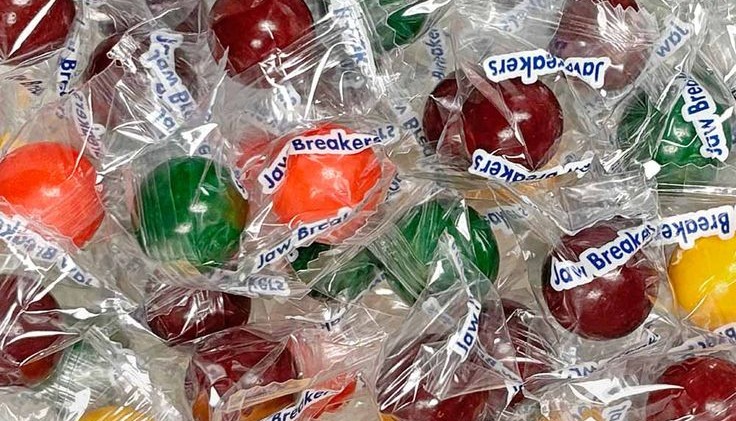
Same hardness, opposite verdict. The difference is who does the breaking. That is the texture rule in two images, and it explains the nougat bars, the taffy and the coconut without a second variable.
The ambivalent middle
Eight candies landed between 27.27% and 64.29%. They inspire neither devotion nor disgust. They are the “fine, I guess” of Halloween, the ones you eat when the good stuff runs out. And the contested zone reveals something the two poles cannot: these are candies where personal history matters more than universal appeal.
The Snickers surprise
America’s best-selling candy bar landed in the middle at 64.29%. Nine of fourteen dots were green, which means a substantial minority actively objected, possibly to the peanut-nougat combination, possibly to the density. Butterfinger sits at exactly the same score for the opposite textural reason: its famously flaky, sticky crunch-dissolve alienates as many people as it attracts.
The nostalgia paradox
Candy corn, Tootsie Rolls and Smarties spark memories without sparking cravings. They are the visual vocabulary of Halloween without being the reward. Candy corn split exactly seven to seven. It survives on iconography, not flavour. Recognition is not the same as desire, which is the same lesson we found when we asked what makes people want a Coke: the icon is not the craving.
Contested
Snickers
America’s best-selling bar, and a third of the room objects
64% split · 9 of 14 dotsContested
Butterfinger
Flaky, sticky crunch-dissolve. Partisans on both sides
64% split · 9 of 14 dotsContested
Sour Patch Kids
Sour sugar over gummy. Distinctive, and divisive
64% split · 7 of 11 dotsContested
Skittles
Fruit shells, a bag torn open, a slight lean to green
62% split · 8 of 13 dotsContested
Smarties
Chalk tablets in a twist of cellophane. Memory, not craving
54% split · 7 of 13 dotsContested
Candy corn
Halloween iconography, not flavour. Split exactly down the middle
50% split · 7 of 14 dotsContested
Tootsie Roll
The memory of chocolate more than chocolate. Present, unremarkable
29% split · 5 of 17 dotsContested
100 Grand
Caramel and crisped rice, leaning hard toward the red pile
27% split · 3 of 11 dotsWhat to do with this
The decision logic translates cleanly, for candy and for any category where the product has to be reached for. The audience is scoring the experience of consuming the thing, and the wrapper is only trusted when it promises a texture the room already wants. It is the same lesson as the orange juice study: the closer the image sits to the actual sensory reward, the more the room trusts it.
Do
- Lead with crunch or snap. The physical experience is the verdict. KitKat, Twix and M&Ms all won on it.
- Pair chocolate with a familiar complement. Peanut butter, caramel, wafer. Reese’s and Twix cleared the bar; nougat did not.
- Keep the packaging bold and recognisable. Every winner is identifiable from across the room.
- Use portion-controlled formats. Fun-size works. The reward arrives without a commitment.
- Deliver exactly what you promise. The winners are famous for having no surprises in them.
Don’t
- Don’t use coconut. In any form. Almond Joy is the great divider, 15 of 19 dots red.
- Don’t make people work. Excessive hardness or stickiness went 13 for 13 red, twice.
- Don’t lead with nougat. Three nougat-forward bars were refused. It has become a liability.
- Don’t confuse recognition with desire. Candy corn is the most Halloween thing on the wall and half the room refused it.
- Don’t prioritise gimmick over taste. The candy necklace took 5 of 6 dots red. Anything that needs explanation or assembly loses.
One caveat, in the report’s own words: what people click may differ from what they would actually eat if handed a bowl. But directional preference? Twenty-six people, three boards, and the same rule on every one. The data is consistent enough to trust.
Frequently asked questions
What was tested in the Halloween candy study?
Three boards of candy images sourced from Google Images: chocolate bars, chewy candy, and bite-size and suckers. Participants dragged green dots onto the candy they like the most and red dots onto the candy they like the least. Twenty-four candies received enough dots to be scored.
Who took part?
Twenty-six people completed the study in October 2025, drawn from a general audience. The report treats the sample as directional rather than statistically definitive, and notes that the pattern held consistently across all three boards.
How do you read the dot maps?
Each board is one of the three walls participants saw. Green dots mark the candy they like most, red dots the candy they like least, and a candy’s score is the share of its own dots that were green, printed beside the count it came from. Candies at 75% or more in one direction are resonant or resistant; the rest are contested.
What does this mean for a food brand?
The room is scoring texture and the reliability of the reward, not the brand and not the category. Lead with a snap or a crunch, pair chocolate with a familiar complement, keep the format small and the promise exact. Coconut, nougat, hardness and stickiness lost regardless of how famous the name on the wrapper was.