
How the study worked
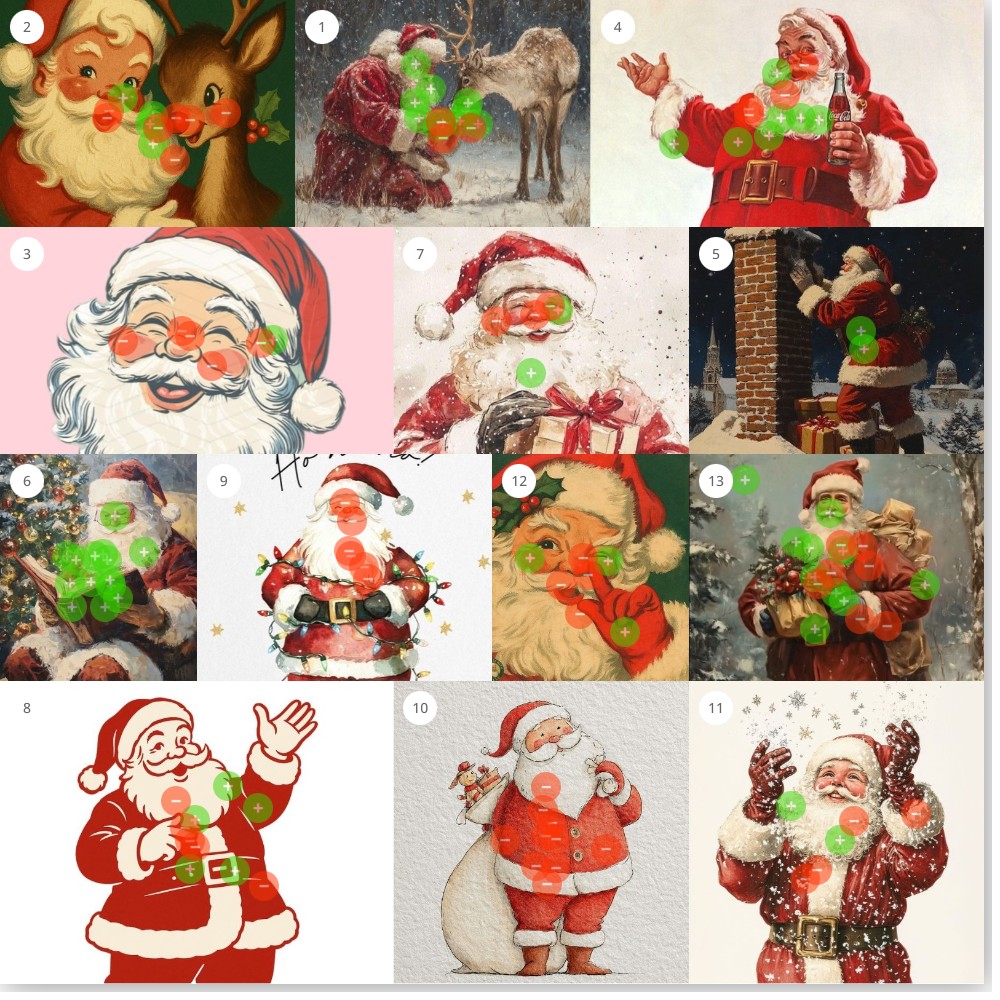
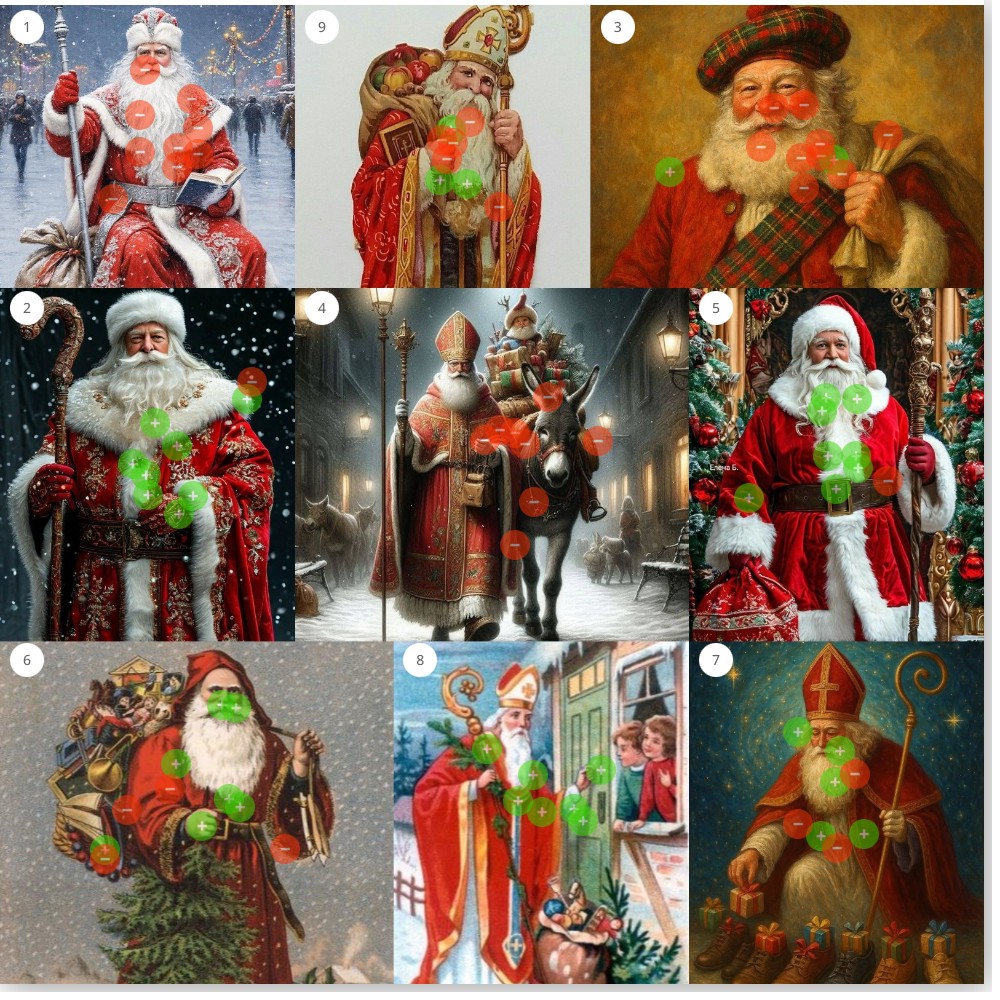
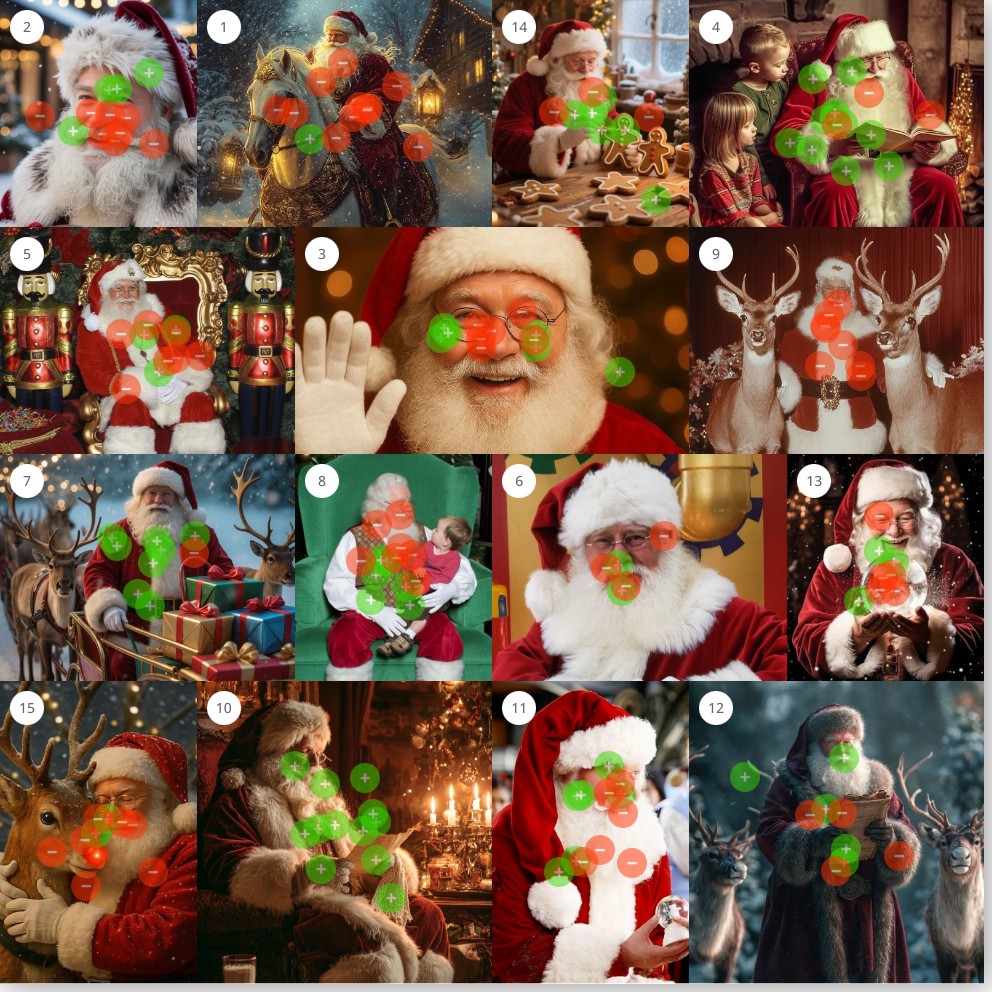
Three boards, 37 images. One board of cartoons and illustrations, one of Saint Nicholas and the old European figure, one of photographs and photo-realistic renders. Twenty-one people got green dots and red dots and a single prompt: green on the images you most associate with the authentic Santa, red on the ones you least associate with him.
The dot maps above are the raw result. At the report’s 75% threshold the 37 images fall into three groups: nine cleared the bar as resonant, nine crossed it as resistant, and nineteen split the room. See the full report for every image and score. What follows is what each group has in common, and it is not what you would guess from the wall.
The moment matters more than the man
People did not judge Santa’s authenticity by how he looks. They judged it by what he is doing. Every image that cleared the threshold shows him engaged in the work: reading a list or a book, tending reindeer, entering a chimney, meeting children at a window. Not one shows him posing. The real Santa is busy, because the magic requires work.
Line all 37 images up by the share of dots they took green and the room’s opinion does not spread across a range. It sorts into three piles with clear water between them.
Figure 2 · Every image, ranked
Principal finding
Authenticity is a stance, not a look. The images that won feel like a glimpse through a window at someone who does not know he is being watched. The images that lost were made to show you Santa. The question the room was answering was not “is this Santa?” but “am I being invited into the magic, or shown a picture of it?”
What won: Santa at work
Nine images cleared the 75% positive threshold. Read together they are a shift on the job: the list, the chimney, the reindeer, the sleigh, the children. Four were unanimous, and the four have almost nothing in common visually. Two are paintings, one is a photograph, and one is a vintage postcard of a bishop.
That postcard is the most instructive result on the wall. Saint Nicholas in mitre and vestments, visiting children at a window, is the image furthest from the American Santa, and it took 100%. Participants recognised a figure with a job to do, a place to do it, and a moment caught mid-story. The costume was beside the point.
Resonance
The candlelit list
Absorbed in a letter, candles and the tree lighting the room
100% greenResonance
The chimney
Sack on his back, one hand on the brick, the city asleep below
100% greenResonance
The book by the tree
Visible brushwork, warm ornaments, a man lost in a page
100% greenResonance
The saint at the window
Mitre, crosier and a sack of toys, children at the sill
100% greenResonance
The elder in the snow
Photoreal portrait with a crook, snow falling, gravitas not jollity
89% greenResonance
The elder by the tree
Staff, sack and a heavy velvet coat against a lit tree
89% greenResonance
The sleigh
Among his reindeer, gifts on the bench, snow in the air
89% greenResonance
The bedtime story
Reading to two children by the fire, nobody looking at the camera
79% greenResonance
Feeding the reindeer
Kneeling in falling snow, an unguarded moment between old friends
77% greenSame suit, softer
The winning Santas wear the canonical red, but rendered soft. Matte, velvet-like fabric with weight to it. Deep crimson and burgundy rather than fire-engine red. Fur trim that looks organic, even slightly yellowed. Falling snow appears in six of the nine. Interiors run on candlelight and hearths. These settings are not backdrops. They are thick enough to be inhabited, and that is what makes the scene feel glimpsed rather than staged.
What lost: four ways to break the spell
Nine images crossed the 75% negative threshold, five of them unanimously. They fail in four distinct ways, and craft saves none of them. Two of the most rejected images on the wall are among the best-made.
Graphic simplification
Three of the most rejected images are simplified illustrations: a retro face on flat pink, a watercolor Santa wrapped in lights, a storybook Santa with a toy sack. Flat colour, no environment, features that emphasise charm over substance. The room read this as a categorical error. These are depictions of Santa for decoration, not depictions as if Santa exists.
Wrong context, wrong animal
The Santa on horseback is beautifully rendered and took 91.67% red. Horses are not part of the mythology, and the violation overrides the execution. Saint Nicholas leading a donkey through a European village went 100% red for the same reason: to this room it is someone else’s Santa.
The staged photo
Santa posed stiffly between two taxidermied deer in front of a red curtain. The sepia does not save it. The deer do not move, he does not engage them, and the backdrop says department store. It captures the performance of Santa rather than the fact of him. Unanimous rejection.
The Rudolph effect
Santa tenderly embracing a reindeer with a glowing red nose should, by the logic of the winners, feel authentic. It took 77.78% red. Rudolph is a 1939 advertising creation, and his presence signals mass-media mythology rather than the older thing the room was reaching for. The image announces its own constructedness.
Resistance
The studio portrait
Posed between two stuffed deer, red curtain behind
100% redResistance
Wrapped in lights
A watercolor Santa tangled in fairy lights under “Ho ho ho”
100% redResistance
The storybook Santa
Cute, flat, a toy sack on paper texture, no world around him
100% redResistance
The donkey
Saint Nicholas and a laden donkey in a snowy European street
100% redResistance
The formal walk
Staff, book and a frontal stare on a lit street, stiff and addressed to you
100% redResistance
The horse
Superbly rendered, and the wrong animal
92% redResistance
The retro face
A laughing head on flat pink, logo-ready
83% redResistance
The tartan Santa
Golden brushwork, a face full of character, and a regional costume
82% redResistance
Rudolph
A tender embrace with a glowing red nose in it
78% redNote · The tartan paradox
The tartan Santa is perhaps the most beautiful image in the resistance array: visible brushwork, warm golden tones, a face with history in it. It took 81.82% red. The tartan introduces a place, and the authentic Santa has to be placeless, belonging equally to everyone. Execution cannot buy back a categorical violation.
The twin test
The cleanest pair on the wall is two photographs on the same board, three tiles apart. Same medium, same red suit, same white beard, same warm grade. One caught him working. One caught him posing.
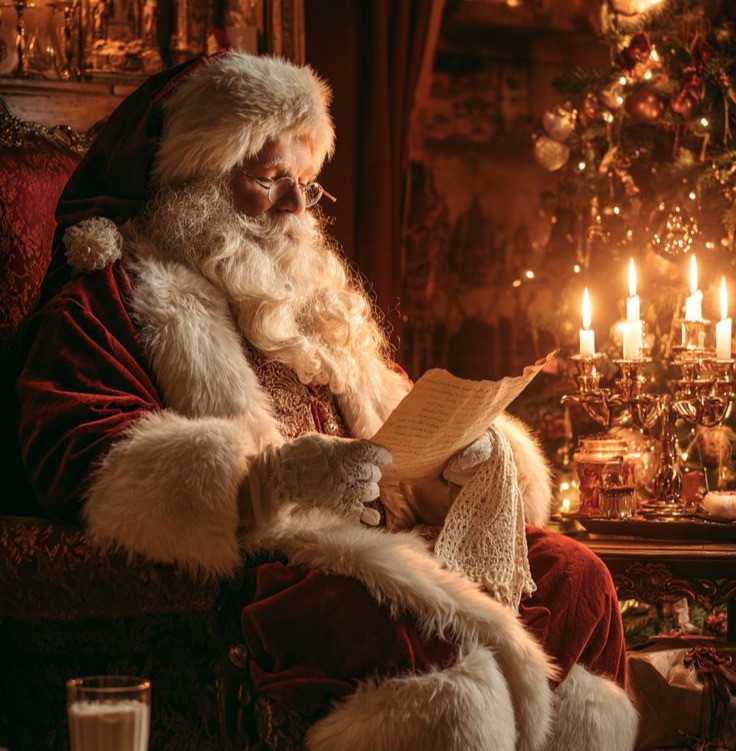
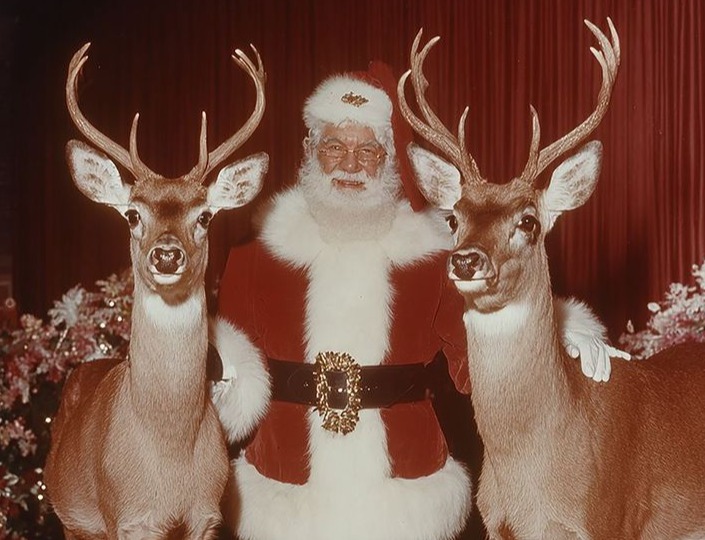
One is a glimpse. The other is a transaction. The room needed no instruction to tell them apart, and the photograph itself, the thing most people would call “realistic,” had nothing to do with the verdict.
Where the room split
Nineteen images landed between 30% and 66.67% green. This is the zone where the room’s two internal models of Santa collide, and the collisions are specific.
The Coca-Cola question
The Haddon Sundblom-style Santa holding a Coca-Cola bottle split 63.64% to 36.36%. Those illustrations defined the modern American Santa, and a third of the room still rejected the progenitor. The bottle is the problem. A commercial artifact punctures the mythological frame, even one this old. Same Santa, different prop, different verdict. It rhymes with what we found when we asked what makes people want a Coke: the icons the brand pays for are not the thing people respond to.
Vintage versus retro
Several vintage-style illustrations sit in this zone, and they sort by actual versus performed age. The print that looks genuinely old, faded colour and period printing artifacts, leans positive at 63.64%. The modern recreations of vintage style lean negative: 42.86%, 40%, 36.36%, 33.33%. The room can tell an heirloom from a reproduction.
The icon problem
The most evenly split image is a stark red-and-cream silhouette of Santa waving. Pure iconography, no context, no activity. Fifty-fifty. This is exactly where the two models conflict: is instant recognisability enough for authenticity, or is it the enemy of it?
Contested
The Coca-Cola Santa
The Sundblom Santa, bottle in hand
64% splitContested
The old print
Genuinely aged: faded colour, a tree under one arm, toys on his back
64% splitContested
Parcels and holly
Painted, carrying gifts through snow, half moment and half pose
59% splitContested
The silhouette
Two-colour graphic Santa, waving at you
50% splitContested
The shush
Retro card Santa, finger to his lips, addressed to the viewer
43% splitContested
The parcel
Vintage style, modern make: a wrapped gift held up to the camera
40% splitContested
The cartoon pair
Retro cartoon Santa cheek to cheek with Rudolph
36% splitContested
Hands to the sky
Retro Santa catching snowflakes, performing delight
33% splitThe mall Santa boundary
Photographs of real men dressed as Santa, in what look like public settings, cluster around the middle. The room was genuinely unsure whether real Santa impersonators doing real Santa work count as authentic. What moves the dot is staging. The gold throne flanked by nutcrackers sinks to 30%. A candid-looking moment icing gingerbread at a kitchen table rises to 66.67%, the best result in the whole contested zone.
The bishop’s hat problem
Two beautifully executed Saint Nicholas paintings with the traditional mitre split the audience, 62.5% and 37.5%. Those who respond to historical rootedness see authenticity. Those who need Santa to be Santa, not his ecclesiastical predecessor, see a different figure entirely. The postcard saint at the window escaped this trap because he was doing something.
Contested
The gingerbread
Icing cookies at a kitchen table, window light, nobody posing
67% splitContested
The seated bishop
Saint Nicholas in a mitre, gifts tucked into boots at his feet
62% splitContested
The fur coat
A weathered Santa in furs, reading, reindeer at his shoulder
56% splitContested
The wave
Waving into the lens, bokeh behind
50% splitContested
The red hood
Hooded, outdoors, an ornament in hand
50% splitContested
The green chair
A real Santa with a baby on his lap, studio chair, studio backdrop
46% splitContested
The mall Santa
Smiling to camera in front of a gold backdrop
40% splitContested
The gilded bishop
Gold mitre, crosier, a sack of apples, looking at you
38% splitContested
The snow globe
Gazing into a glowing globe, a prop doing the work
38% splitContested
The grin
Close portrait, laughing at the camera, lights behind
33% splitContested
The throne
Gold throne, nutcracker guards, the department store made visible
30% splitThe gold throne is death. The intimate moment with a child is life. A real Santa actor can score like the candlelit list if the frame hides the staging and shows the work.
What to do with this
The decision logic translates cleanly into holiday art direction, whether the Santa is painted, rendered or hired. It is the same lesson the orange juice study taught in a different category: the audience trusts the thing caught being itself, and reads every layer of presentation as distance.
Do
- Catch him in the act. Reading names, adjusting a bridle, brushing snow off his coat. Activity implies existence.
- Build the room. Weather, flickering light, visible breath, details that reward a second look. Dense environments read as a real place.
- Go warm and muted. Burgundy over fire-engine red, cream and gold over pure white, candlelight over daylight.
- Give the fabric weight. Fur with strands, velvet with nap, surfaces that look touchable, in paint or in pixels.
- Keep the canon. Reindeer, sleigh, chimney, list, sack. The anchors keep the category clear.
Don’t
- Don’t simplify him into a graphic. Flat colour and empty backgrounds read as commercial intent.
- Don’t let him address the viewer. Winking, pointing, posing. We should witness, not be solicited.
- Don’t change the animal. Horses and donkeys were rejected regardless of execution.
- Don’t give him a place. Tartan, flags, regional costume. The authentic Santa belongs to everyone.
- Don’t hand him a product. Even the Coca-Cola bottle, the most storied prop in the category, cost him a third of the room. Rudolph cost him more.
One caveat from the report: this was a sample of 21, and the people who sort Santa imagery are gift-buyers, marketers and experience designers, not young children. The signal is directional and unusually clean. It says the same thing on all three boards.
Frequently asked questions
What was tested in the Santa study?
Thirty-seven images of Santa Claus across three boards: cartoons and illustrations, Saint Nicholas and the old European figure, and photographs and photo-realistic renders. Participants placed green dots on the images they most associated with the authentic Santa and red dots on the ones they least associated with him.
Who took part?
Twenty-one people completed the study in December 2025. The report treats the sample as directional, and notes that the strong rejection of European Saint Nicholas imagery suggests a predominantly American frame of reference.
How do you read the dot maps?
Each board is one of the three walls the participants saw. Green dots mark an association with the authentic Santa, red dots mark the least association, and the score for each image is the share of its own dots that were green. Images with 75% or more in one direction are resonant or resistant; the rest are contested.
What does this mean for a holiday campaign?
Show Santa doing the work, in a place dense enough to believe in, and keep the props out of his hands. The medium is free: paintings and photographs both cleared the bar. Posed, simplified, regional or commercial treatments lost, and craft did not save them.